
Review · TOKYO CITY TOURS
Calligraphy Culture SHODO Experience in Tokyo
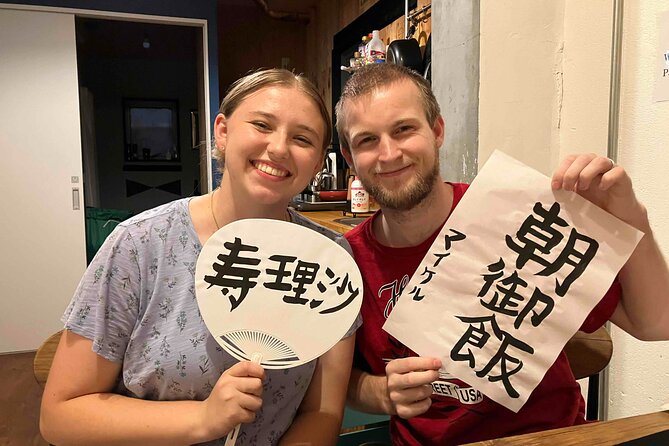
Japanese calligraphy beats a postcard every time. This small-group Shodo lesson lets you write your own name in kanji, hiragana, or katakana, with beginner-friendly coaching. I like the way the class starts with basics like brush hold and posture, then quickly moves into characters you can actually take home.
Two things I really like are the patient, English-friendly instruction (teachers like Zuisen and Sachie are known for it) and the take-home autograph board with your finished work. One possible drawback to plan for: the workshop takes place in a local building where day-to-day activity in shared spaces can occasionally interrupt the quiet focus you might expect.
Key highlights worth planning around
- 90-minute, small-group format with a maximum of 5 people, so you get real attention
- Write your own name or a favorite word in Japanese characters, guided from the first stroke
- Learn the fundamentals of Shodo: brush grip, posture, and how to draw clean lines
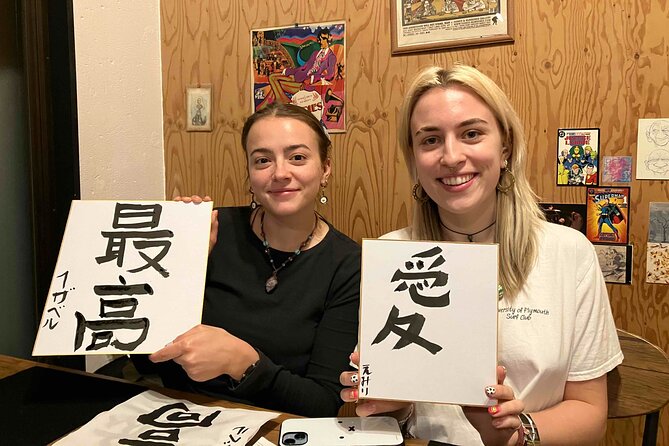
- Take-home autograph board so the lesson becomes a physical souvenir, not a memory-only experience
- Near Iriya Station (about a 5-minute walk), with easy connections around Asakusa and Ueno
Japanese Shodo in Tokyo: more than pretty handwriting
Shodo is often described as Japanese calligraphy, but the practical point is this, you are learning a method. You start with body position and brush control, then work your way toward writing that looks like it belongs in a traditional space.
That matters because most beginner art activities stay at the fun stage. Here, you get steps you can repeat. You learn how to manage line thickness and direction, how a stroke begins and ends, and how the right posture makes the brush behave. Even if your first attempt looks rough, you will understand why it looks that way.
And because you end by writing something personal, it does not feel like copying worksheets forever. You can choose to write your name in Japanese, or a favorite word in kanji. You leave with a result that feels like it came from you, not from a printer.
You can also read our reviews of more tours and experiences in Tokyo.



Getting to Tokyo Iriya Shodo Club without stress
Your meeting point is Tokyo Iriya Shodo Club, at 2-chōme 29-2, 2階, Iriya, Taito City, Tokyo 110-0013. It’s close enough that you can build it into an Asakusa or Ueno day without treating it like a whole expedition.
The workshop is a 5-minute walk from Iriya Station, and it is also near public transportation overall. That helps if you are juggling a busy itinerary, like temple visits in the morning and a train ride toward Ueno or back to your hotel after.
One planning detail I recommend: book ahead. It is commonly reserved about a month in advance on average, so if your dates are fixed, securing a slot early keeps your options open. You’ll get confirmation at booking time, and you’ll use a mobile ticket.
Your 90-minute Shodo flow, step by step
Expect about 1 hour 30 minutes in total, and the class ends back at the meeting point. Here is what the structure feels like, from first instructions to final take-home work.
1) Set up the basics, brush hold and posture
The lesson starts with fundamentals. You learn how to hold the brush, how to set your posture, and how to approach the first lines with steadiness. This is not just for tradition, it’s practical. When your hand and body align, the brush moves more predictably, and your strokes come out cleaner.
This portion is also where most beginners find their footing. Even if you are not familiar with hiragana, katakana, or kanji, you are given the starting point.
2) Learn how strokes work before tackling your word
After you understand the basics, the class focuses on how to draw lines that look intentional. Think in terms of direction, pressure, and the shape of each stroke. You’re not trying to be a calligraphy master in one session. You are trying to learn the rules that make the difference between shaky and controlled.



3) Write your own name or a favorite word
Then you get into the fun part. You write your name in Japanese, or your favorite word in kanji. For people who want a challenge, this can mean working with characters that have more complex structure.
The class is designed for foreign visitors, and instruction is offered in English, which is a big deal for confidence. You are not left to figure out characters from a screen and hope for the best.
4) Finish with a take-home autograph board
At the end of the lesson, you create a finished piece on a cardboard board. You take it home as a souvenir. This is one of the best parts of the experience because you get an actual object to frame, display, or pack carefully in your luggage.
Choosing what to write: name, kana, or kanji
This is where you can tailor the lesson to your goals.
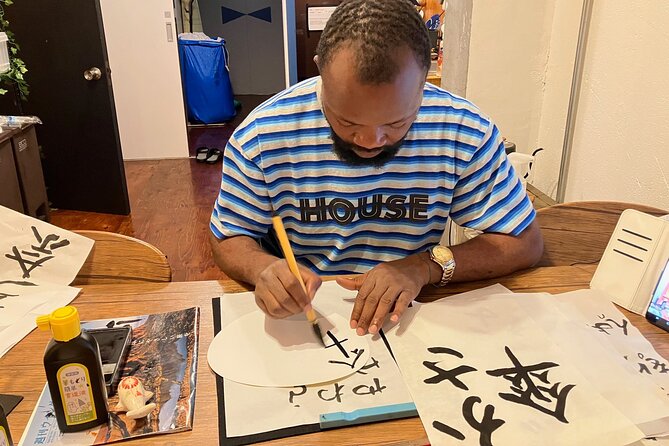
If you want the simplest, most personal option, write your name. You can choose Japanese writing styles for your name, including katakana. That means you get a result that looks like it belongs on Japanese signage or a nameplate, and it is usually easier to match your spelling and pronunciation.
If you want something more meaningful, try a favorite word in kanji. Kanji can feel intimidating at first, but that’s also why the structure of the class helps. You are taught the strokes you need, instead of being thrown into character shapes with no method.
One extra detail I like about this approach is how it helps you notice Japanese writing as a system. After the lesson, hiragana, katakana, and kanji stop being random alphabets and become parts of one writing culture.
Teacher quality and why small groups feel different here
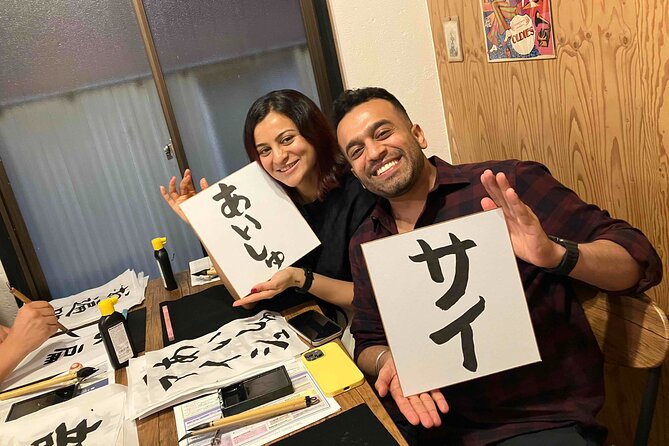
A big part of the value is the teaching style. The strongest notes from past sessions are about friendly guidance and patient coaching. Names you may hear include Zuisen and Sachie, both known for being very willing to slow down and explain.
Small group size is not just a comfort perk, it changes how you learn. With a maximum of 5 people, you are more likely to get quick corrections. If your brush hold is off or your posture needs adjusting, you can get nudges early rather than waiting for the end.
And if the room is quiet and the teacher has time, you may even get extra personal help. That is especially helpful when you pick characters you know you will struggle with.
The local building detail: cozy, but not always silent
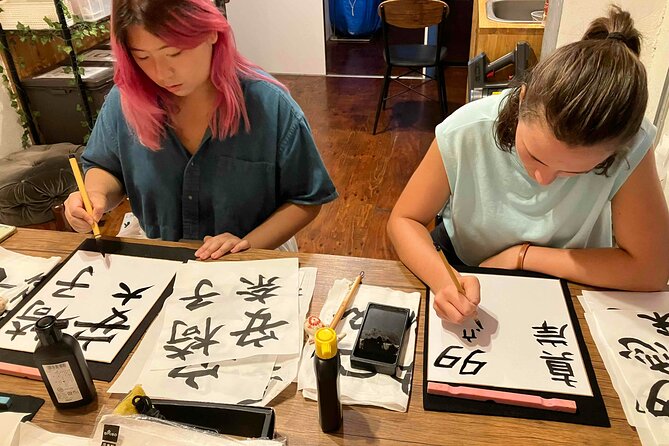
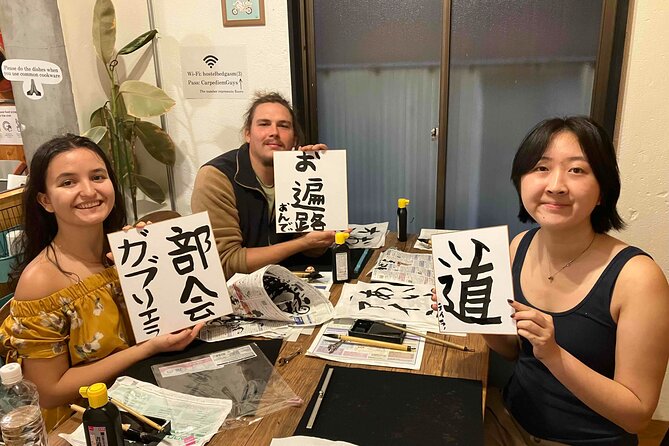
Here’s the honest trade-off. The workshop space is in a local building that can include shared areas where other people live or work. In at least some sessions, people in the shared space may be cooking or washing clothes while class is happening.
I would not call this a deal-breaker, but it is something to consider. If you strongly prefer a quiet art studio atmosphere, you might find the background activity distracting. The good news is that the class itself is still focused, and the group size stays small.
If you are sensitive to noise, plan to arrive a little early, settle in quickly, and bring the mindset of learning through real life. Tokyo is a city of shared spaces, and sometimes the authenticity comes with minor interruptions.
Supplies included, and why $33.03 is fair value
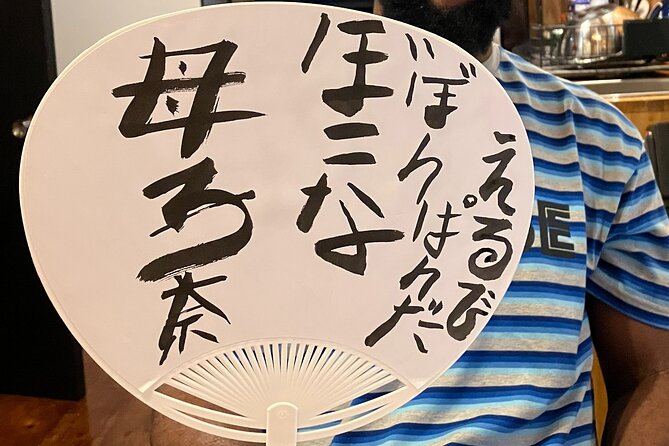
The price is $33.03 per person, and the duration is about 1 hour 30 minutes. On paper, that sounds modest. In practice, it is a fair deal because supplies are included and you receive a take-home board.
You are not just watching someone demonstrate. You’re getting instruction, practice time, and a finished souvenir that you can pack and keep. The class also sits in a convenient part of Tokyo for day-trip plans around Asakusa and Ueno.
So the value is not only the artwork. It’s the combination of guidance plus an end product. Many cheaper activities give you a craft with minimal teaching. This one gives you a skill framework you can repeat later if you want to practice again.
Where this Shodo experience fits best on your Tokyo trip
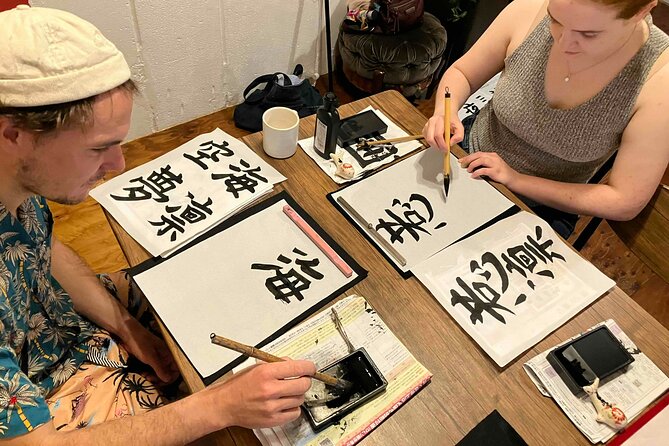
This is a great choice if you want a culture activity that is:
- Hands-on instead of just sightseeing
- Beginner-friendly, with structured coaching
- Personal, because you choose your name or a favorite word
- Easy to schedule around an Asakusa or Ueno day
It also works well for travelers who want something different from the usual “museum and photos” loop. Calligraphy gives you something tangible, and it slows your day down in a good way.
If you are traveling with family, it can be a fun way to teach kids that Japanese culture has craft skills, not just places to visit. And if you are traveling solo, the small-group approach means you are not lost in a crowd.
Who should book, and who might want a different class
Book this experience if you:
- Want to learn Shodo basics like posture and brush control
- Care about a real souvenir made by your own hand
- Like small, teacher-led activities where you can ask questions in English
- Are curious about how Japanese characters are formed
You might choose something else if you:
- Need a totally quiet, studio-style environment
- Are expecting a formal gallery setting rather than a classroom in a local building
- Want a super long workshop, because this one is about getting you through the core steps in 90 minutes
Should you book Tokyo Iriya Shodo Club?
Yes, I think you should book it if you want a meaningful Tokyo activity that feels practical, personal, and doable. The small-group cap, beginner coaching, and take-home board make the experience feel complete instead of rushed.
If you are on the fence, here is my simple decision rule. If you are excited to write your name or a favorite word and you can handle a slightly lived-in classroom vibe, this fits your trip perfectly. If you need a quiet, upscale studio with zero background activity, look for a different calligraphy option.
FAQ
How long is the Calligraphy Culture Shodo Experience?
The experience lasts about 1 hour 30 minutes.
What is the price per person?
It costs $33.03 per person.
Where do I meet for the Shodo experience?
You meet at Tokyo Iriya Shodo Club, 2-chōme 29-2, 2階, Iriya, Taito City, Tokyo 110-0013, Japan.
Is the location near public transportation?
Yes. The meeting place is near public transportation, and it is about a 5-minute walk from Iriya Station.
Do I get calligraphy supplies, or should I bring my own?
Calligraphy supplies are included.
What can I write during the lesson?
You can write your name in Japanese or your favorite word in kanji, with instruction from the basics.
How big is the group?
The class has a maximum of 5 travelers.
Do I take anything home?
Yes. At the end of the lesson, you can take home an autograph board with your own work.
Is it a mobile-ticket experience?
Yes. The tour includes a mobile ticket.
More Tour Reviews in Tokyo


Not for you? Here's more nearby things to do in Tokyo we have reviewed












Tokyo City Tours, side by side.
 ★ 5.01-Day Tokyo Bus TourFrom $12914,250 reviews
 ★ 4.5TOKYO SKYTREE® Admission ticketFrom $1311,192 reviews
 ★ 4.6teamLab Planets TOKYO Digital Art Museum Entry TicketFrom $259,779 reviews
 ★ 4.0Mt Fuji & Hakone Cruise, Drum Show Bullet Train 1 Day from TokyoFrom $1497,413 reviews
 ★ 5.0Shinjuku Food Tour (13 Dishes at 4 Local Eateries)From $866,603 reviews
 ★ 4.4Tokyo Mt Fuji 5th St & Hakone Cruise Bus Tour w/Bullet TrainFrom $1545,024 reviews
 ★ 5.0Flagship 2-Hours Official Street Go-Kart Tour – Tokyo Bay ShopFrom $644,974 reviews
 ★ 4.5From Tokyo: Mount Fuji Full-Day Sightseeing TripFrom $684,970 reviews