
Review · TOKYO CITY TOURS
Tokyo: 1.5-Hour Edo Kiriko Glass Cutting Workshop in Sumida
Cut glass in Tokyo, in calm hands. This 1.5-hour Edo Kiriko workshop in Sumida turns a traditional cut-glass craft into something you actually do, not just watch.
I love seeing artisans work in a real studio, with safety and technique explained in a way you can follow even if it is your first time.
I also love the way they build confidence with a short practice session before you cut your final piece. The main drawback is that beginners may feel they could use a bit more hands-on coaching once the real cutting starts.
Key highlights you will feel right away
- Real artisan process, not a staged show, with you watching professionals work in the studio.
- Practice-first training, using tools on test pieces so your hands learn before your glass does.
- Pick from daily-changing glass choices, so your finished piece has real variety.
- You cut your own pattern, guided enough to start, free enough to make it yours.
- Small group size (max 4), which keeps attention closer when questions pop up.
Sumida’s working studio: Edo Kiriko made practical
Edo Kiriko is Tokyo’s famous cut-glass craft. In this workshop, you are not just learning the idea. You are standing close to the process, seeing how the glass is marked and shaped, then trying it yourself.
The setting is in Sumida, and the workshop is indoors. That matters in Tokyo, because weather can mess with plans. You also get a tighter feel to the class thanks to the small group size, capped at four participants.
Time is nicely contained. The workshop runs about 90 minutes, which is long enough to learn the basics and finish a keepsake, but short enough that you will not feel stuck in a half-day commitment. If you are juggling other Tokyo stops, this fits cleanly.
More Tokyo tours and experiences for the shortlist



Watch first, then handle the tools
A big part of the value here is the order of operations. You start by watching craftsmen at work. You see how they handle the tools and how they stay focused on control, not force.
After that, the workshop does something smart for first-timers: you practice with the tools before cutting your own design. This is where you really understand why Edo Kiriko pieces are worth the price. Cutting glass is not just about making lines. It is about consistent pressure, clean contact, and patience.
The guidance is provided through English support, with a live guide who can translate between Japanese and English. In practice, this means you are not left guessing what the instruction means. You also get a calmer classroom vibe, with the message that mistakes are part of learning, not a reason to feel embarrassed.
One thing to consider: the structure can feel a bit relaxed. That is refreshing if you like experimenting. If you are the type who freezes without constant correction, you might wish for tighter supervision during your first cuts.
Choosing your glass: daily variety, real character
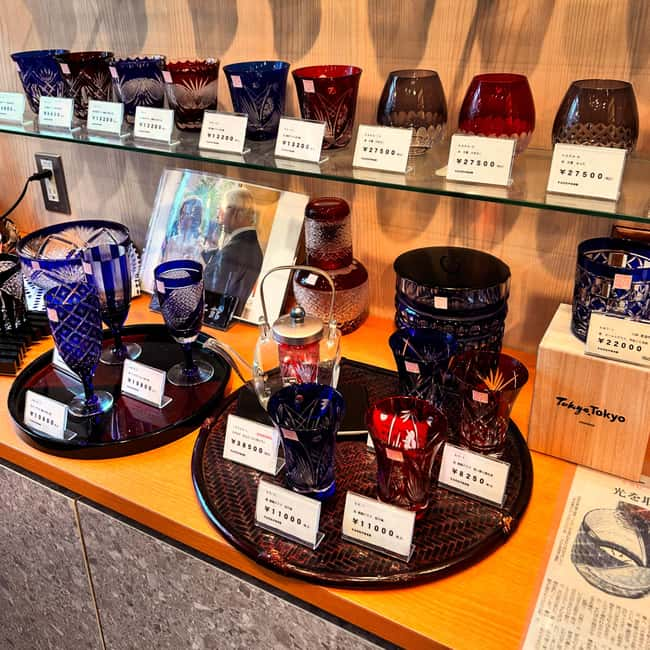
Before you commit, you choose your glass from a changing daily stock. The workshop highlights that each piece is one-of-a-kind, and the selection changes. That is more interesting than picking from a fixed shelf of identical blanks.
For adults and older kids, your project is a drinking glass. For elementary-aged children, the project changes to a lidded container. The goal is the same, but the work is scaled to age, which helps everyone get a result they can actually finish.
This choice step is also part of the fun. You get to decide what kind of look you want before the cutting starts. And once you pick, you can focus on your pattern rather than spending the whole class second-guessing the material.
Cutting your pattern: guided enough, free enough
Once you start cutting, you will feel the workshop’s balance. You get direction on safety and technique, but you also have room to make decisions. That is a key reason this class can be memorable even for people who do not usually do hands-on crafts.
The cutting itself takes focus and dexterity. It is not hard in the sense of being unsafe, but it is challenging in the sense that your brain and hands have to coordinate. The craft rewards steady attention, not speed.
The workshop is designed so beginners can participate. You are not expected to walk in already knowing how to handle professional tools. Still, you should expect a learning curve. If you are prone to rushing, slow down. Clean work happens when you pause and reset your angle.
What you take home: a real keepsake, not a souvenir printout
At the end, you take your finished Edo Kiriko piece home. That is the point. This is not a class where you leave with photos and a worksheet.
Because you are cutting your own design, your glass or lidded container has a personal story built in. Even if your pattern is simpler than you dreamed, it still reflects your choice of glass and your own line work.
You will also have a chance to visit the on-site shop. That shop is where you can compare what you made to what artisans sell. It is also where you will see modern collaborations and recognizable brands mixed into Edo Kiriko style, including partnerships like Starbucks.
Just note: shop purchases are not included in the workshop price. This is one of those experiences where you will probably end up tempted, so it helps to decide your budget before you browse.






Price and value: is $122 fair for Edo Kiriko?
At $122 per person for about 90 minutes, this workshop is not cheap. But the value comes from what is included: guided instruction, a practice session with tools, watching artisans work, and time to cut your own glass or container.
You are paying for two things that are hard to DIY. One is access to a real working studio. The other is supervision while you use professional tools on glass. That combination is what turns Edo Kiriko from a museum idea into a skill you understand through your own hands.
If you compare it to buying a finished cut-glass souvenir, the workshop can feel like a fair trade. Buying a piece is quick. Cutting your own costs time, but you get the education built into the experience and you end up with something personal.
Also, the small group setup helps justify the price. With max four participants, you are more likely to get your questions answered. That attention is part of what makes the session feel doable.
English support, photos, and the calm tone that helps
The workshop includes English-speaking support, and the live guide works in Japanese and English. For many people, that is the difference between a hands-on class that feels relaxing and one that feels confusing.
Photography is allowed, but only in designated areas. This is common in studios where equipment and working zones need protection. Still, it gives you a chance to capture the process and the final piece, as long as you follow the on-site instructions.
The overall tone is also important. One highlight from recent sessions is that people are not scolded for mistakes. You practice, you try again, and you learn. That kind of atmosphere makes it easier for beginners to stay focused.
There is also a practical detail worth keeping in mind: hotel pickup and drop-off are not included. Plan to get to the studio on your own, then enjoy the session without worrying about timing a car.
Who this fits best in your Tokyo plan
This is ideal if you want a Tokyo souvenir that is hands-on, not just something you carry in a bag. It is also a great option if you like crafts, tool work, or watching artisans in a working environment.
It is suitable for participants from 4th grade elementary school and older. Adults must accompany children, though companions can observe without cutting. The workshop is not suitable for children under 9, which lines up with the grade guidance.
Adults and middle school students cut drinking glasses. Elementary children cut lidded containers. If you are traveling as a family, this means everyone can participate, but your projects will differ based on age.
Two more practical notes:
- Pets are not allowed.
- The workshop is wheelchair accessible, since it takes place indoors and the venue is set up for access.
Timing tips and how to get the most out of the 90 minutes
Because the workshop is 90 minutes, treat it like a small appointment, not an open-ended wander. You will do best if you arrive a bit early, settle in, and then let the guide walk you through the flow.
The class moves through phases: observation, tool practice, glass selection, then actual cutting. If you are the type who gets anxious, the practice-first step can calm you down fast. It also helps you understand how small adjustments change your results.
Wear comfortable clothes you do not mind getting close to glass tools. The workshop is indoors, so you also can avoid weather layers that complicate movement.
Should you book this Edo Kiriko workshop in Sumida?
I think you should book it if you want something tangible, skill-based, and personal in Tokyo. The combination of real artisan observation, practice with tools, and then cutting your own design makes this one of those rare classes that teaches you while you create.
Skip it or reconsider if you need lots of constant correction. The experience can feel relaxed rather than strict, which is great for many people, but you might want more guidance if you are extremely nervous about doing it wrong.
It is also a good pick if you are traveling with kids who are old enough for the correct project type. Adults and older kids make drinking glasses, elementary kids make lidded containers, and the adults can join the cutting while companions can observe.
If you are building a Tokyo day with culture plus a hands-on payoff, this workshop is a smart use of 90 minutes.
FAQ
How long is the Edo Kiriko glass workshop in Sumida?
The workshop lasts 90 minutes (listed as 1.5 hours).
What do adults and children cut in the workshop?
Middle school students and adults cut drinking glasses. Elementary school children cut lidded containers.
What is the minimum age to join?
The activity is suitable from 4th grade elementary school and older, and it is not suitable for children under 9.
Is the workshop wheelchair accessible?
Yes. The workshop is wheelchair accessible.
Is photography allowed during the workshop?
Photography is allowed, but only in designated areas.
What is included in the price?
The price includes the 1.5-hour guided workshop, a practice session with tools, the glass-cutting experience (glass or lidded container), observation of artisans at work, and English-speaking support.
Can I cancel and get a refund?
Yes. Free cancellation is available up to 24 hours in advance for a full refund.
More Workshops & Classes in Tokyo

More Tour Reviews in Tokyo
Not for you? Here's more nearby things to do in Tokyo we have reviewed












Tokyo City Tours, side by side.
 ★ 5.01-Day Tokyo Bus TourFrom $12914,250 reviews
 ★ 4.5TOKYO SKYTREE® Admission ticketFrom $1311,192 reviews
 ★ 4.6teamLab Planets TOKYO Digital Art Museum Entry TicketFrom $259,779 reviews
 ★ 4.0Mt Fuji & Hakone Cruise, Drum Show Bullet Train 1 Day from TokyoFrom $1497,413 reviews
 ★ 5.0Shinjuku Food Tour (13 Dishes at 4 Local Eateries)From $866,603 reviews
 ★ 4.4Tokyo Mt Fuji 5th St & Hakone Cruise Bus Tour w/Bullet TrainFrom $1545,024 reviews
 ★ 5.0Flagship 2-Hours Official Street Go-Kart Tour – Tokyo Bay ShopFrom $644,974 reviews
 ★ 4.5From Tokyo: Mount Fuji Full-Day Sightseeing TripFrom $684,970 reviews
This tour also belongs to