
Review · TOKYO CITY TOURS
Authentic Japanese calligraphy class in Tokyo! Kanji your name
Kanji, in your own hand. This private Japanese calligraphy lesson with Maki-san turns a cultural curiosity into a hands-on skill, with one-to-one guidance in a local home.
Two things I really like: you get careful, step-by-step coaching on posture and brush grip, and you leave with a finished piece written on traditional paper. The one consideration is simple logistics, it is in Setagaya, so plan your trip to Yōga Station area and count the time for getting there and back.
A real shodo class, not a photo op
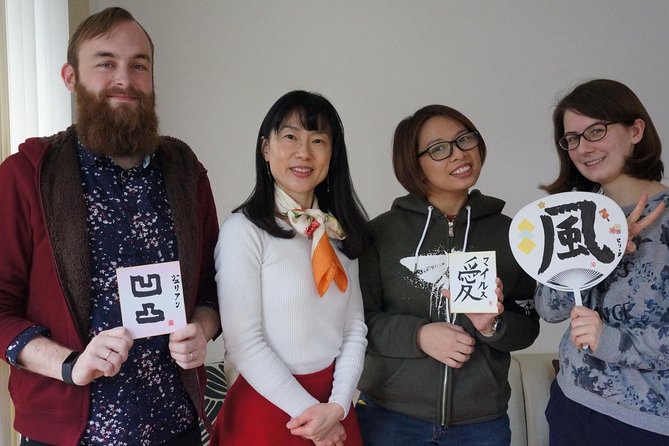
What you’re signing up for is Japanese calligraphy, or shodo, the kind you practice with physical tools, not just videos on your phone. The magic here is the setting. The lesson happens in the instructor’s home, so the atmosphere feels lived-in and calm, not like a classroom assembled for tourists.
You’ll learn the basics that make calligraphy look right: correct posture, the way you hold the brush, and the practical know-how behind making clean strokes. And because it is private, you do not compete with other people for attention. You can ask, repeat, and get feedback until your strokes feel more controlled.
The other reason this stands out is that you are not just copying symbols. You get to write a word or character on Japanese traditional paper, and you take that creation home. That part matters, because calligraphy is one of those arts where the process sticks in your hands, not just in your memory.
The only drawback to keep in mind is location. The address is near Yōga Station in Setagaya, and private transportation is not included. If you are staying far from this area, you’ll want to build in transit time so you arrive relaxed, not rushed.
Key highlights you should plan around
- One-to-one instruction in a local home with Maki-san, so questions are welcome and feedback is direct
- Step-by-step brush technique, including posture and how to hold the brush for better control
- Write your own kanji or word on traditional paper, then take it home as a keepsake
- Tools and paper are provided, including practice paper and materials for a finished piece
- Clear English coaching, with a teacher who repeats key points until they land
- A personal, cultural conversation, not just a mechanical lesson, with space to talk about Japanese tradition
More Tokyo tours and experiences for the shortlist



From Yoga Shrine to a calligrapher’s home
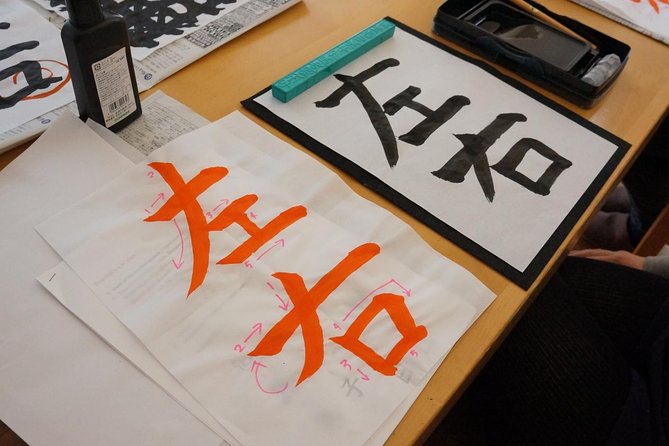
Your session is tied to a real neighborhood in Setagaya. The activity starts near Yōga Station, with the meeting point listed at Yōga Sta.2 Chome-39 Yoga, Setagaya City, Tokyo. The itinerary calls out Yoga Shrine as the first stop, which is a handy mental anchor.
Here’s why that matters: calligraphy is intimate. You want to arrive at a place that feels quiet and normal, not a loud meeting point where everyone is checking their phones. A shrine nearby also helps set the tone. Even if you only glance at it before you head to the lesson space, it signals that you are in the everyday rhythm of Tokyo, not only the tourist circuit.
At the end, it returns you back to the meeting point. So you are not stuck figuring out how to get home from the middle of nowhere.
What you learn: writing systems, posture, and brush control
This class is built like a mini foundation course. You begin by learning about different writing systems, then you move into the practical stuff you can feel immediately.
You will cover:
- the calligraphy tools you will use
- how to hold the brush correctly
- proper posture
- how to write a word or character on traditional paper
That may sound basic, but it is exactly what makes the difference between messy strokes and calligraphy that looks intentional. In many workshops, the focus is only on copying a sample. Here, the teaching time goes into technique, so you understand what your hand should do.
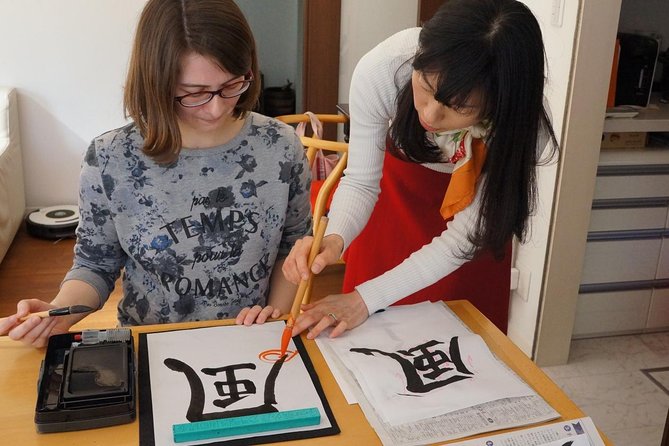
Posture is the hidden superpower. When your body is stable, your brush lines become steadier. That stability affects everything, from the thickness of the stroke to the smoothness of the curve. Same with brush grip. When you hold the brush in a way that matches how the ink flows, you can control pressure better and make strokes look less like rushed handwriting.
And because the instruction is private, you can slow down. One review noted that Maki repeats explanations and keeps the class very participative. That matters if you are the kind of person who needs to hear the same cue in a slightly different way before it clicks.
Kanji your name: the moment the lesson becomes personal
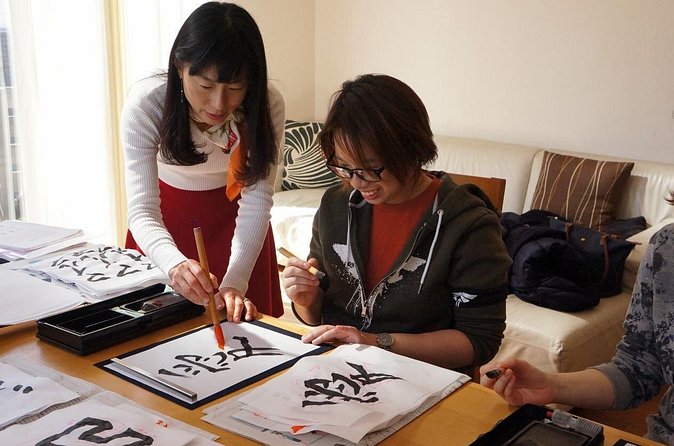
The title of the experience points to a big draw: you will work on writing your name in kanji. The class format also says you can write a word or character on Japanese traditional paper. So for many people, this is the part that turns the session from interesting into memorable.
Here’s the practical way to think about it. Your goal is not to produce calligraphy that looks like a museum piece on stroke one. Your goal is to create something you can live with, something that represents your name and your effort. Calligraphy is a craft where small corrections matter, and the teacher can guide you toward strokes that look more balanced.
You will also get taught how to create your calligraphy on traditional paper, not modern templates. That is a different experience. Traditional paper tends to respond to pressure and brush movement in a way that digital writing never will. When you do it by hand, you learn what “control” really means.
If you want a souvenir that feels uniquely yours, this is the best angle. A printed postcard is easy. Your own kanji, created with guidance, is the kind of item you keep.
Tools and take-home paper: what you receive
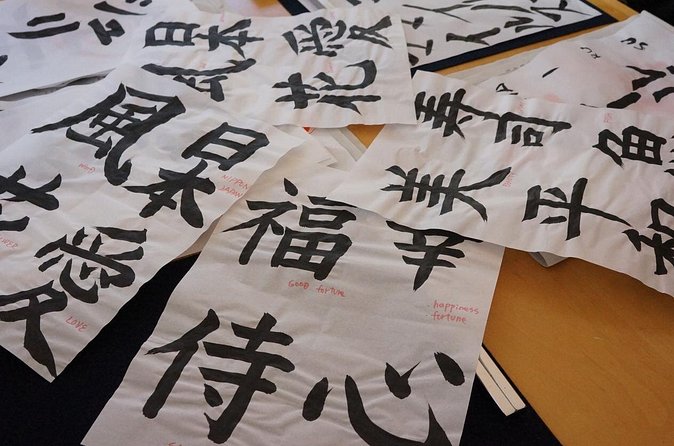
You get a lot of the setup done for you. Included in the experience fee are the calligraphy tool and materials needed for both practice and a finished piece.
What is listed as included:
- experience fee
- calligraphy tool
- colored paper (or fan)
- paper for practice
- consumable supplies
- consumption tax
That list tells you how to plan. You do not need to bring calligraphy supplies. You also have a structure: practice first, then create on traditional paper for the final result.
The mention of colored paper (or a fan) suggests you might choose a format for your finished work, depending on what the class uses that day. Either way, you are taking home something more than a single scrap of paper. This is the kind of souvenir that works well in a frame or as part of an item display at home.
One small detail from reviews is worth noting: Maki had drinks laid out to try for some participants. That is not listed in the core materials, so I would treat it as a pleasant bonus, not a guarantee. But it fits the overall vibe. This is not a factory workshop, it is a host-and-student setup.






Why the price makes sense for a private class
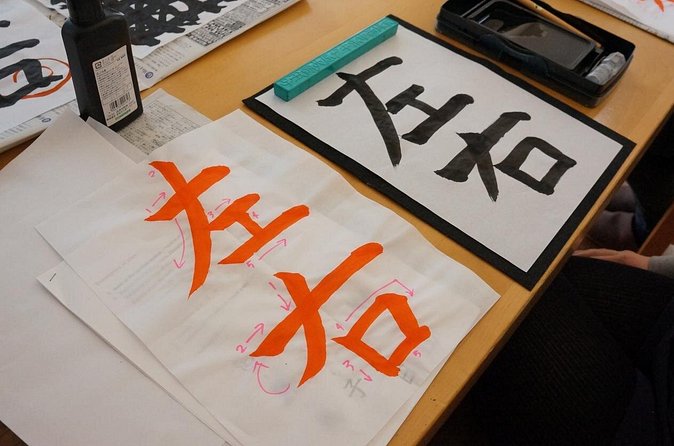
At $56 for about 1 hour 30 minutes, this is not a budget group activity. It is a paid, private lesson with supplies included, in a real home setting.
So where does the value come from?
First, you are paying for attention. One-to-one coaching in Tokyo can easily cost more when it includes materials. Here, the lesson includes tools, practice paper, consumables, and the final paper materials. That means you are not doing an extra supply run after the class.
Second, the teacher’s time is structured around technique. You are learning posture, brush grip, and how to write your chosen character or word. That is why the session feels like more than entertainment. It is instruction you can carry forward if you want to keep practicing.
Third, the “private home” setting adds something you cannot copy online. You get a cultural experience that is tactile and personal. You are not just watching someone demonstrate. You are doing the strokes, with corrections.
If you like hands-on Tokyo experiences and you want something that is distinctly Japanese, this price feels fair. If you only want a quick activity for an hour, you might compare it to cheaper group workshops. But for a private shodo session that hands you your own finished work, it checks out.
Maki-san’s teaching style, clear English, and patient repetition
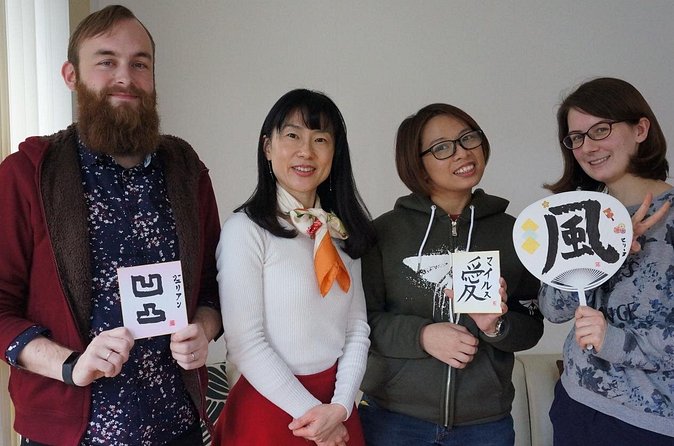
A lot of calligraphy classes assume you are already comfortable with the basics. This one does not. Multiple reviews highlight how well Maki-san explains techniques in English, and how carefully she breaks things down.
What that means for you on the day:
- You can follow the instructions even if you do not know Japanese calligraphy already
- You can ask for clarification and get it again
- The class stays participative, not passive
One review described her as super professional and systematic, and another pointed out that she did not mind repeating the same explanations many times. That repetition is not a flaw here. It is the teaching method. Calligraphy has a few key rules, and the hand learns them through practice, not through one short explanation.
I also liked the idea that the lesson includes cultural talk along with technique. When the teacher explains why certain approaches matter, your strokes improve faster. You stop treating it like copying and start treating it like craft.
And if you are celebrating something, that personal touch can matter. One review mentioned a surprise birthday preparation. If you are planning a special occasion, you could consider reaching out ahead of time to ask whether a personal touch is possible, but treat that as an inquiry, not a promise.
Practical advice so your class feels smooth
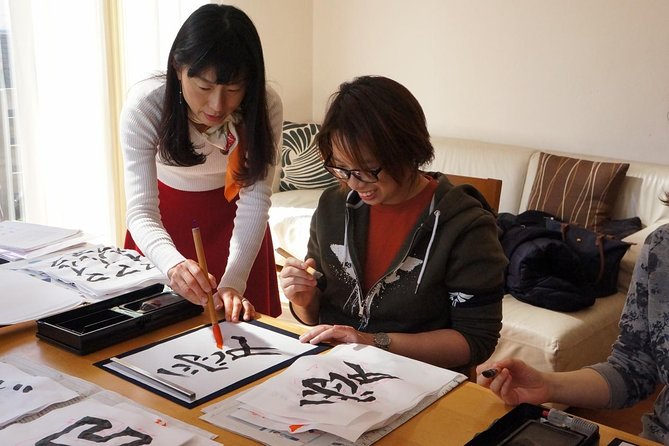
This is the part people forget until they are standing in a side street wondering where to go.
- Plan transit around Yōga Station and Yoga Shrine. The meeting point is near Yōga Station, and Yoga Shrine is referenced as the first stop. Arrive a bit early so you have time to settle.
- Wear clothes you can move in comfortably. Posture matters in calligraphy, and you will likely be sitting or holding a stable position while writing. You do not want to fuss with restrictive clothing.
- Expect to start with basics, not only your final character. The structure includes tools and posture first. That is good news. Technique learning reduces frustration during the part where you write your name or word.
- Keep your expectations realistic. Your goal is a finished piece you can take home, and technique that improves as you go. Even if it is not perfect on the first attempt, you will still produce a meaningful souvenir.
- Bring questions. If you are curious about writing systems, stroke order logic, or how to practice after the lesson, ask. The class is private, so your questions get attention.
Who should book this shodo class
This lesson is a strong fit if you:
- want an authentic Japanese culture activity in Tokyo that is not just watching
- enjoy hands-on arts and want to learn a skill you can keep practicing
- want a private experience rather than a crowded group session
- like the idea of a meaningful souvenir written by you in kanji
It is also a great option for people who are short on time but still want something memorable. At 1 hour 30 minutes, you get a full lesson arc, technique to finished product, without turning your day into a half-day project.
If you are in Tokyo for the classic sights only and you do not care about craft, you might feel like this is too niche. But if you want Tokyo beyond the landmarks, this is a practical way to do that.
Should you book? My straight answer
Book it if you want a real shodo experience with guidance that helps you improve while you create your own kanji. The best parts are the private pacing, the careful step-by-step coaching, and the fact that you take home a finished piece on traditional paper.
Skip it only if you cannot make it to the Yōga Station area without major stress, or if you are looking for a fast, passive activity. This is not a stand-and-watch show. It is an active class, and that is the point.
If you do book, treat it like a mini craft workshop. Arrive calm, listen closely, and let the repetition do its job. You’ll leave with something more personal than a photo.
FAQ
How long is the Japanese calligraphy class?
The class lasts about 1 hour 30 minutes.
Is this a private lesson or a group activity?
It is a private tour or activity, so only your group participates.
Where do we meet in Tokyo?
The start location is listed near Yōga Station at Yōga Sta.2 Chome-39 Yoga, Setagaya City, Tokyo 158-0097, Japan. The activity ends back at the meeting point.
What will I learn and what will I write?
You will learn about writing systems, the calligraphy tools, correct posture, and how to hold the brush. You will write a word or character on Japanese traditional paper.
What is included in the price?
Included are the experience fee, calligraphy tool, colored paper (or a fan), paper for practice, consumable supplies, and consumption tax.
How does transportation work?
Private transportation is not included. The meeting point is near public transportation.
What is the cancellation policy?
You can cancel for a full refund if you cancel up to 24 hours in advance of the experience start time. If you cancel less than 24 hours before, the amount paid is not refunded.
More Workshops & Classes in Tokyo

More Tour Reviews in Tokyo
Not for you? Here's more nearby things to do in Tokyo we have reviewed












Tokyo City Tours, side by side.
 ★ 5.01-Day Tokyo Bus TourFrom $12914,250 reviews
 ★ 4.5TOKYO SKYTREE® Admission ticketFrom $1311,192 reviews
 ★ 4.6teamLab Planets TOKYO Digital Art Museum Entry TicketFrom $259,779 reviews
 ★ 4.0Mt Fuji & Hakone Cruise, Drum Show Bullet Train 1 Day from TokyoFrom $1497,413 reviews
 ★ 5.0Shinjuku Food Tour (13 Dishes at 4 Local Eateries)From $866,603 reviews
 ★ 4.4Tokyo Mt Fuji 5th St & Hakone Cruise Bus Tour w/Bullet TrainFrom $1545,024 reviews
 ★ 5.0Flagship 2-Hours Official Street Go-Kart Tour – Tokyo Bay ShopFrom $644,974 reviews
 ★ 4.5From Tokyo: Mount Fuji Full-Day Sightseeing TripFrom $684,970 reviews
This tour also belongs to